
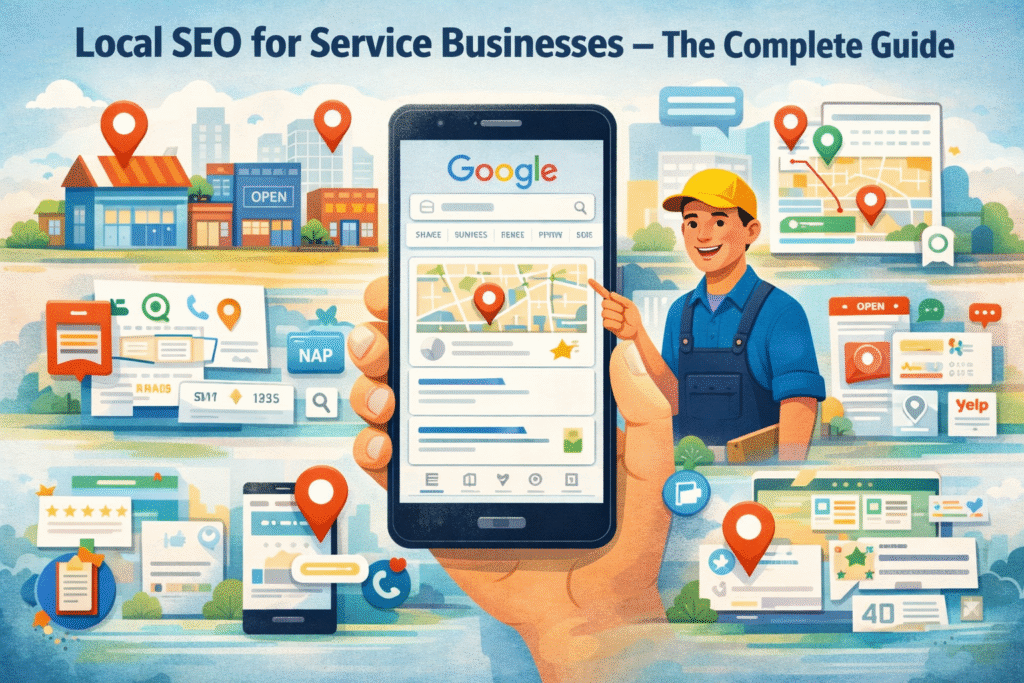
Introduction
If you run a service-based business, local SEO isn’t optional anymore—it’s your primary growth engine. In 2026, customers don’t “browse”; they search with intent like “near me,” “best,” or “open now.” If your business doesn’t appear in local results, you’re invisible.
This complete guide breaks down exactly how service businesses can dominate local search and convert nearby searches into real customers.
What Is Local SEO?
Local SEO is the process of optimizing your online presence so your business appears in local search results, Google Maps, and “near me” searches.
It helps service businesses like:
- Plumbers
- Electricians
- Clinics
- Digital agencies
- Consultants
- Home service providers
…get discovered by customers in their service areas.
Why Local SEO Matters More in 2026
Search engines now prioritize:
- Proximity
- Relevance
- Trust signals
- User behavior
With AI-driven search results and voice queries on the rise, local businesses with strong signals win visibility—even against bigger brands.
Step 1: Optimize Your Google Business Profile (GBP)
Your Google Business Profile is your local SEO foundation.
Must-do optimizations:
- Accurate business name, address, and phone number
- Correct service categories
- Detailed service descriptions
- High-quality photos & videos
- Regular posts and updates
- Active Q&A section
💡 Tip: Businesses with complete profiles get significantly more calls and direction requests.
Step 2: Nail NAP Consistency Everywhere
NAP = Name, Address, Phone Number
Ensure consistency across:
- Website
- Google Business Profile
- Social media
- Business directories
- Review platforms
Inconsistent details confuse search engines and hurt rankings.
Step 3: Location-Based Keyword Optimization
Target keywords that include:
- City
- Area
- Service type
Examples:
- “AC repair in Bangalore”
- “Digital marketing agency in Mysuru”
- “Emergency plumber near me”
Use them naturally in:
- Page titles
- Headings
- Service pages
- URLs
- Meta descriptions
Step 4: Create Location-Specific Service Pages
If you serve multiple locations, create dedicated pages for each area.
Each page should include:
- Local service description
- Area-specific FAQs
- Testimonials from local customers
- Embedded Google Map
Avoid duplicate content—make each page unique.
Step 5: Collect & Manage Online Reviews
Reviews are a major local ranking factor.
Best practices:
- Ask happy customers for reviews
- Respond to every review (yes, even negative ones)
- Use keywords naturally in responses
- Maintain a steady review velocity
⭐ Pro tip: Recent reviews matter more than old ones.
Step 6: Local Citations & Business Listings
List your business on trusted directories like:
- Bing Places
- Justdial
- Sulekha
- Yelp
- Industry-specific platforms
Quality > quantity. Focus on authoritative listings.
Step 7: Local Content That Converts
Create content focused on:
- Local problems
- Seasonal services
- Area-specific guides
- Local case studies
Examples:
- “Best time for AC servicing in Mysuru”
- “Common plumbing issues in apartment buildings”
This builds topical authority + local relevance.
Step 8: Mobile Optimization Is Non-Negotiable
Most local searches happen on mobile.
Ensure:
- Fast load speed
- Click-to-call buttons
- Easy navigation
- Mobile-friendly design
Google indexes your mobile site first—no exceptions.
Step 9: Use Local Schema Markup
Structured data helps search engines understand your business.
Add schema for:
- Local business
- Services
- Reviews
- FAQs
This improves visibility in rich results and voice search.
Step 10: Track & Improve Performance
Monitor:
- Google Business insights
- Website traffic from local keywords
- Call and form conversions
- Review growth
Local SEO is ongoing—not a one-time setup.
Common Local SEO Mistakes to Avoid
❌ Keyword stuffing
❌ Fake locations
❌ Ignoring reviews
❌ Duplicate location pages
❌ No local content strategy
Final Thoughts
Local SEO in 2026 is about trust, relevance, and user experience. Service businesses that invest in local visibility today will dominate their markets tomorrow.
If your customers are local, your SEO strategy must be too.