
Introduction
In 2026, publishing blogs consistently is no longer enough. Thousands of articles are published every minute, yet only a small percentage ever rank—or drive meaningful traffic. The difference isn’t frequency; it’s strategy.
So, what kind of blog posts actually rank and drive long-term organic growth?
This guide breaks down the exact content types, structures, and intent signals search engines reward today.
Why Most Blog Content Fails to Rank
Most blogs fail because they:
- Target keywords without search intent
- Cover topics too broadly or too shallowly
- Lack topical authority
- Don’t demonstrate real expertise
- Ignore internal linking and content clusters
Ranking content today must solve a problem better than everything else on the page.
The Core Principle: Search Intent > Keywords
Before writing anything, understand why the user is searching.
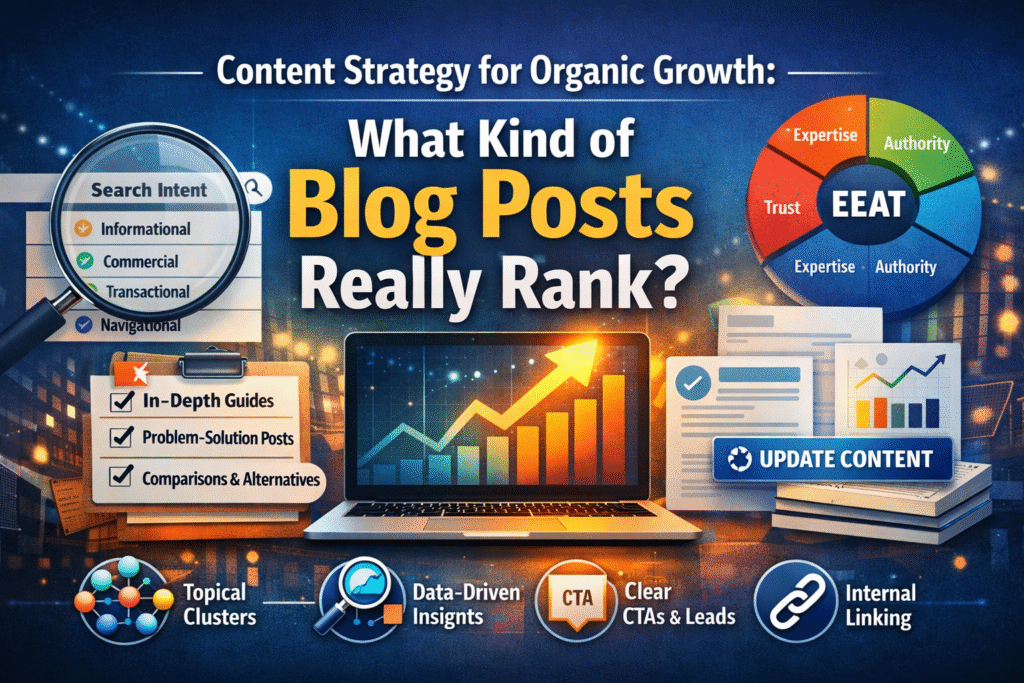
In 2026, search intent falls into four main categories:
- Informational – learning something
- Commercial – comparing options
- Transactional – ready to buy
- Navigational – finding a brand or page
The best-performing blogs align perfectly with one intent—never all four.
Blog Post Types That Really Rank in 2026
1. In-Depth Guides (Pillar Content)
These are long, comprehensive resources that cover a topic end-to-end.
Why they rank:
- High dwell time
- Strong EEAT signals
- Easy to build internal links around
Examples:
- “The Complete Guide to Local SEO”
- “SEO for SaaS: From Zero to Scale”
2. Problem-Solution Posts
These focus on specific pain points, not generic topics.
Why they rank:
- Match high-intent searches
- Lower competition
- Higher conversion rates
Example:
“How to Fix Low Website Conversions Without Increasing Traffic”
3. Comparison & Alternatives Posts
Search engines love content that helps users decide.
Why they rank:
- Strong commercial intent
- High engagement
- Natural backlink potential
Examples:
- “WordPress vs Webflow for Small Businesses”
- “Best CRM Tools for Service Businesses”
4. Topical Cluster Blogs (Supporting Content)
These support a main pillar page and target related subtopics.
Why they rank:
- Strengthen topical authority
- Improve internal linking
- Help multiple pages rank together
Think ecosystem, not isolated posts.
5. Data-Backed & Experience-Driven Content
Original insights beat generic AI-written blogs.
What works best:
- Case studies
- Experiments
- Real examples
- First-hand experience
Google heavily rewards Experience in EEAT.
Content Depth Beats Content Length
Longer doesn’t mean better.
Better means:
- Clear structure
- Actionable steps
- Examples and frameworks
- Updated information
A 1,200-word article that fully solves the query will outperform a 3,000-word fluff piece.
Internal Linking: The Hidden Ranking Multiplier
Blogs that rank rarely stand alone.
High-ranking sites:
- Link related articles together
- Use descriptive anchor text
- Guide users deeper into the topic
Internal links help search engines understand content hierarchy and authority.
Freshness & Content Updates Matter
In competitive niches, updating old content is often easier than ranking new posts.
Best practices:
- Update statistics
- Improve examples
- Add new sections
- Refresh meta titles/descriptions
Content freshness is a ranking accelerator, especially in fast-moving industries.
Blogs That Rank Also Convert
Organic growth isn’t just traffic—it’s qualified traffic.
Ranking blogs include:
- Clear CTAs
- Trust signals
- Lead magnets
- Logical next steps
Traffic without conversion is vanity.
Final Thoughts
In 2026, blogs that rank are:
✔ Intent-driven
✔ Topically connected
✔ Experience-based
✔ Strategically structured
Organic growth comes from publishing less, but smarter.
If your content answers real questions better than anyone else, rankings follow naturally.