
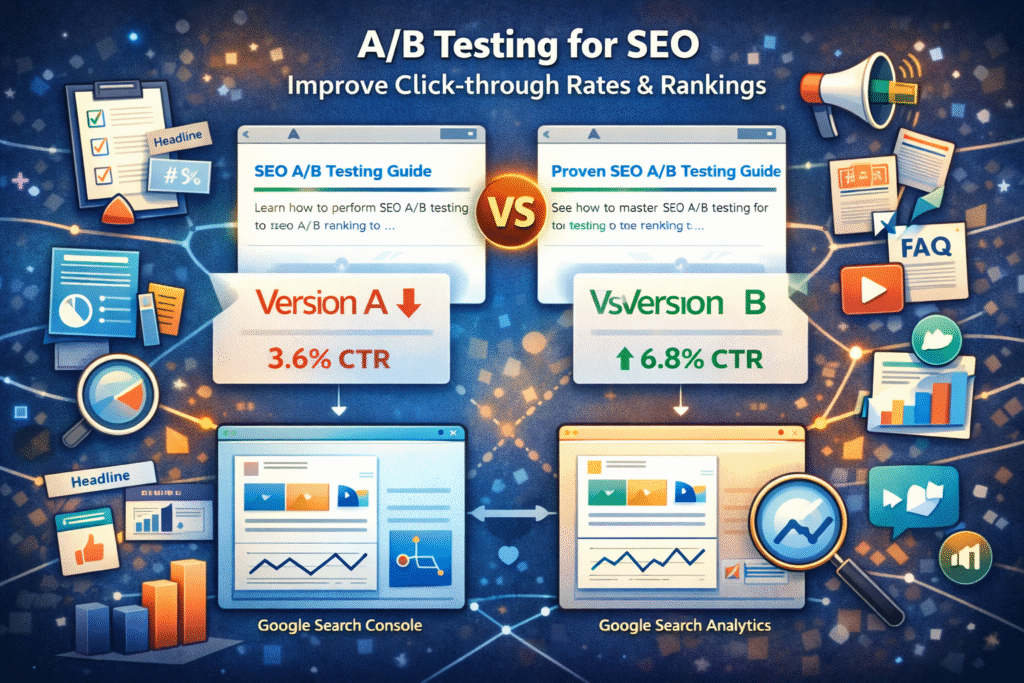
Introduction
SEO is no longer just about ranking—it’s about earning the click. In 2026, with AI summaries, featured snippets, and crowded SERPs, ranking on page one doesn’t guarantee traffic.
This is where A/B testing for SEO becomes a game-changer.
By systematically testing elements like titles, meta descriptions, and on-page content, you can improve click-through rates (CTR), user engagement, and ultimately search rankings—without creating new pages.
What Is A/B Testing in SEO?
A/B testing (also called split testing) in SEO involves comparing two variations of a page or element to determine which performs better in organic search.
Instead of guessing what works, you use data to optimize performance.
Common SEO elements tested include:
- Meta titles
- Meta descriptions
- Headings (H1/H2)
- Content structure
- Internal linking
- CTAs
Why A/B Testing Matters for SEO in 2026
Search engines increasingly use user behavior signals such as:
- Click-through rate
- Dwell time
- Bounce rate
- Engagement depth
If users consistently click your result and stay longer, it sends a strong relevance signal to search engines.
A/B testing helps you:
- Increase organic CTR
- Improve user experience
- Validate SEO decisions
- Maximize traffic from existing rankings
What You Should (and Shouldn’t) A/B Test for SEO
Safe SEO Elements to Test
These won’t risk penalties or indexing issues:
- Meta titles & descriptions
- Headline phrasing
- FAQ sections
- Content formatting
- Internal link placement
Avoid Testing
❌ URL structures
❌ Canonical tags
❌ Index/noindex rules
❌ Core page intent
SEO testing must be controlled and non-disruptive.
A/B Testing Meta Titles to Improve CTR
Why Titles Matter
Your title is the first impression in search results.
You can test:
- Numbers vs no numbers
- Emotional vs neutral wording
- Brand name inclusion
- Power words (“Proven”, “Complete”, “2026”)
Example:
- Version A: Local SEO Guide for Service Businesses
- Version B: Local SEO for Service Businesses: Proven Growth Guide
Track which version earns higher CTR in Google Search Console.
Testing Meta Descriptions for Better Engagement
Meta descriptions don’t affect rankings directly—but they influence clicks.
Test variations with:
- Clear value propositions
- CTAs (“Learn”, “Discover”, “See how”)
- Pain-point framing
Higher CTR often leads to improved rankings over time.
On-Page A/B Testing for Rankings
Test Content Structure
You can experiment with:
- Bullet points vs paragraphs
- Short intros vs long intros
- FAQ sections added at the bottom
These impact dwell time and readability, both important ranking signals.
How to Run SEO A/B Tests Properly
Step 1: Select Similar Pages
Choose pages with:
- Similar intent
- Similar traffic levels
- Stable rankings
This ensures accurate comparisons.
Step 2: Change One Variable at a Time
Never test multiple elements simultaneously.
Bad test ❌: Title + description + H1 changed
Good test ✅: Only meta title changed
Step 3: Measure the Right Metrics
Track:
- CTR (Google Search Console)
- Impressions
- Average position
- Engagement metrics
Run tests for 2–4 weeks minimum.
Step 4: Implement Winners at Scale
Once you identify a winning variation:
- Roll it out across similar pages
- Standardize best-performing formats
This compounds SEO gains over time.
Tools for A/B Testing SEO
Popular tools include:
- Google Search Console
- Google Analytics
- SEO testing platforms
- Custom page grouping frameworks
Even manual testing can deliver strong results when done consistently.
Common A/B Testing Mistakes in SEO
❌ Testing too many changes at once
❌ Not waiting long enough
❌ Ignoring seasonality
❌ Testing low-traffic pages
❌ Drawing conclusions without data
SEO testing rewards patience and discipline.
Final Thoughts
In 2026, the biggest SEO wins don’t always come from ranking higher—but from getting more clicks from the rankings you already have.
A/B testing allows you to:
✔ Optimize with confidence
✔ Improve CTR without new content
✔ Strengthen behavioral ranking signals
SEO isn’t just about visibility anymore—it’s about performance.