
Introduction
Even the best content won’t rank if search engines can’t crawl, index, and understand your website properly. That’s where technical SEO comes in.
A technical SEO audit helps uncover hidden issues that block rankings, reduce crawl efficiency, and hurt user experience. In 2026, with AI-driven search and stricter quality signals, technical health is non-negotiable.
This step-by-step walkthrough shows you exactly how to perform a technical SEO audit that improves visibility, performance, and rankings.
What Is a Technical SEO Audit?
A technical SEO audit is the process of evaluating your website’s infrastructure and backend elements to ensure search engines can:
- Crawl your site efficiently
- Index the right pages
- Understand page structure
- Deliver fast, secure user experiences
Unlike content audits, technical audits focus on how your site works—not what it says.
When Should You Perform a Technical SEO Audit?
You should audit your site when:
- Rankings drop suddenly
- Traffic stagnates despite good content
- Launching or redesigning a website
- Migrating domains or URLs
- Scaling content rapidly
For most websites, a quarterly audit is ideal.
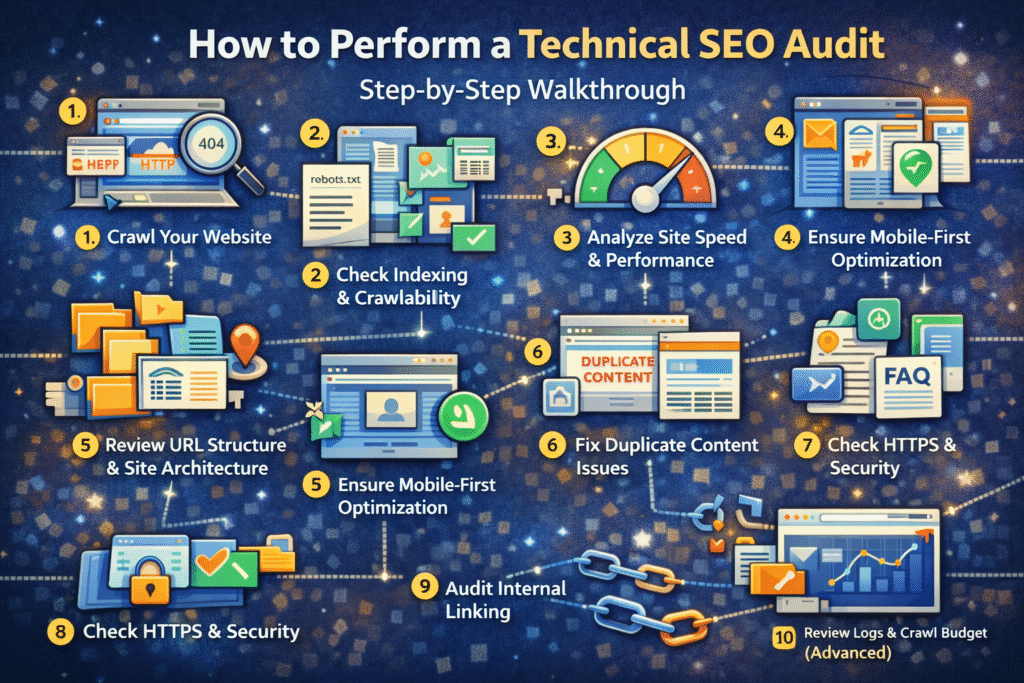
Step 1: Crawl Your Website
Start by crawling your site the same way search engines do.
Look for:
- Broken links (4xx errors)
- Redirect chains
- Duplicate pages
- Orphan pages
This gives you a high-level health snapshot of your site.
Step 2: Check Indexing & Crawlability
Ensure search engines can access the right pages.
Audit:
- robots.txt file
- Noindex tags
- Canonical tags
- Sitemap accuracy
Common mistake: important pages accidentally blocked or set to noindex.
Step 3: Analyze Site Speed & Performance
Page speed is a confirmed ranking factor.
Focus on:
- Largest Contentful Paint (LCP)
- Interaction to Next Paint (INP)
- Cumulative Layout Shift (CLS)
Optimize:
- Images
- Server response time
- JavaScript execution
- CSS delivery
Faster sites = better rankings + conversions.
Step 4: Ensure Mobile-First Optimization
Google indexes the mobile version of your site first.
Check:
- Mobile responsiveness
- Font readability
- Button spacing
- Navigation usability
A desktop-only optimized site will struggle in 2026.
Step 5: Review URL Structure & Site Architecture
Clean architecture helps both users and crawlers.
Best practices:
- Logical folder structure
- Short, descriptive URLs
- Consistent naming conventions
- No unnecessary parameters
A well-structured site distributes authority more effectively.
Step 6: Fix Duplicate Content Issues
Duplicate content confuses search engines.
Audit for:
- HTTP vs HTTPS duplicates
- WWW vs non-WWW
- Parameterized URLs
- Similar product/service pages
Use canonical tags correctly to signal the preferred version.
Step 7: Check HTTPS & Security
Security is a trust signal.
Ensure:
- HTTPS enabled across all pages
- No mixed content warnings
- Valid SSL certificate
Non-secure sites lose both trust and rankings.
Step 8: Implement Structured Data (Schema)
Schema markup helps search engines understand context, not just content.
Add schema for:
- Organization
- Local business
- Articles
- FAQs
- Reviews
This improves eligibility for rich results and AI summaries.
Step 9: Audit Internal Linking
Internal links guide crawlers and users.
Check for:
- Broken internal links
- Over-optimized anchors
- Important pages buried too deep
Strong internal linking boosts crawl efficiency and rankings.
Step 10: Review Logs & Crawl Budget (Advanced)
For larger sites, analyze server logs to see:
- Which pages bots crawl most
- Wasted crawl budget
- Ignored important pages
This is critical for eCommerce and content-heavy sites.
Common Technical SEO Mistakes to Avoid
❌ Blocking pages unintentionally
❌ Ignoring mobile performance
❌ Leaving broken redirects
❌ Duplicate content across URLs
❌ Skipping schema markup
Technical SEO mistakes compound over time if ignored.
Final Thoughts
A technical SEO audit isn’t a one-time task—it’s ongoing maintenance.
In 2026, websites that rank consistently are:
✔ Fast
✔ Secure
✔ Crawlable
✔ Structured
✔ User-friendly
Fix the foundation, and everything else performs better.