
Introduction
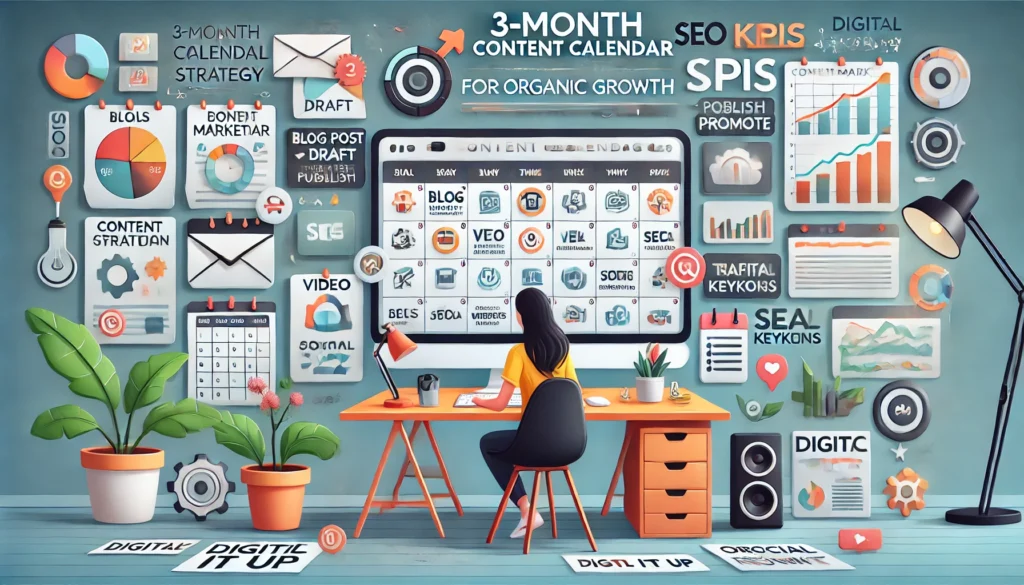
Planning your content in advance is one of the most powerful ways to drive organic growth. A structured 3-month content calendar gives you direction, consistency, and ensures every piece of content works toward your business goals. At Digital It Up, we help you map out content that not only gets published—but ranks, engages and converts.
1. Define Your Goals & KPIs
Before you pick topics or set dates, you need clear objectives. Ask yourself:
- What do I want to achieve in the next three months (e.g., increase organic traffic by 20 %, gain 500 email subscribers, improve engagement)?
- Which KPIs will measure progress (organic sessions, keyword rankings, time on page, conversion rate)?
Setting these early ensures your calendar is goal-driven, not just a schedule of disparate posts.
2. Audit Your Current Content & Audience
Take stock of what you already have:
- Which blog posts or pages are performing well?
- What keywords are ranking?
- What gaps exist in your content?
Also, revisit your target audience: what are their pain points, search intent, typical questions?
This gives you a base to build from and avoid duplicating effort.
3. Research Topics & Keywords
Now you list content ideas with intent and data behind them:
- Use tools like Google Keyword Planner, Ahrefs, or SEMrush to identify topics with search volume and manageable competition.
- Look for long-tail keywords or question formats (e.g., “how to plan content calendar for organic growth”).
- Mix evergreen topics (long-term value) and timely/seasonal topics (short-term bursts).
As shown in guides for building content calendars, research is the backbone of planning.
4. Choose Content Formats & Channels
Decide the types of content you’ll publish over the three months: blog posts, infographics, videos, newsletters, social posts.
Map each type to a channel (your website, YouTube, Instagram, LinkedIn, email).
By diversifying formats and channels, you increase organic reach and engagement.
5. Create the 3-Month Calendar Structure
Break down the next three months in a spreadsheet or project tool. At minimum, include columns for:
- Date of publication
- Title/topic
- Target keyword(s)
- Format/type
- Channel(s)
- Assigned author/editor/designer
- Status (idea → draft → review → publish)
- Promotion plan
As highlighted in content calendar guides, details and status tracking are important.
Example:
Month 1: Weekly blog posts, bi-weekly social posts, one infographic.
Month 2: Repeat but introduce a guest post and one video.
Month 3: Focus on topic cluster + update older high-potential posts + campaign piece.
6. Map Promotion & Distribution
Publishing the content is only half the job. For organic growth you must promote and distribute it:
- Link from other pages on your site (internal linking)
- Share on social media channels
- Feature in email newsletters
- Reach out for backlinks (guest posts, collaborations)
- Repurpose content in other formats (e.g., blog → infographic → social micro-posts)
This integrated plan boosts visibility and ranking potential.
7. Assign Responsibilities & Workflow
Make sure every piece of content has an owner and clear steps: topic approval, writing, editing, design, SEO review, publish, promote.
A smooth workflow reduces bottlenecks and keeps content consistent. Calendar systems with status-tracking help
8. Monitor, Review & Adjust
Every month you should review what’s working and adjust for the next month. Metrics to check:
- Which posts got the most traffic and which didn’t?
- Which keywords moved up/down in ranking?
- What formats or channels delivered best?
Then refine your calendar: drop or revise under-performers, double-down on winners. As content-calendar thought-leaders say: calendars must evolve, not stay static.
9. Update & Optimize Existing Content
Part of your 3-month plan should include updating older posts that have ranking potential but are stale. This has two benefits: improvements to existing content and steady production load. Example: Month 3 could include “Update top 5 posts from last year.”
10. Build in Flexibility & Buffer Content
Even the best-planned calendars need room for spontaneous content: trending topics, news, product launches, reactive posts. Leave ~10-20 % of your calendar open so you can pivot when needed.
Conclusion
A 3-month content calendar is more than a schedule—it’s a strategic roadmap for organic growth. By defining goals, doing research, mapping topics with formats, scheduling promotion, tracking responsibilities and reviewing performance, you’ll elevate your content from random posts to an engine that drives traffic, rankings and conversions.
At Digital It Up, we help businesses implement content strategies that deliver measurable results. Ready to build your 3-month content calendar together? Let’s plan, execute and grow.